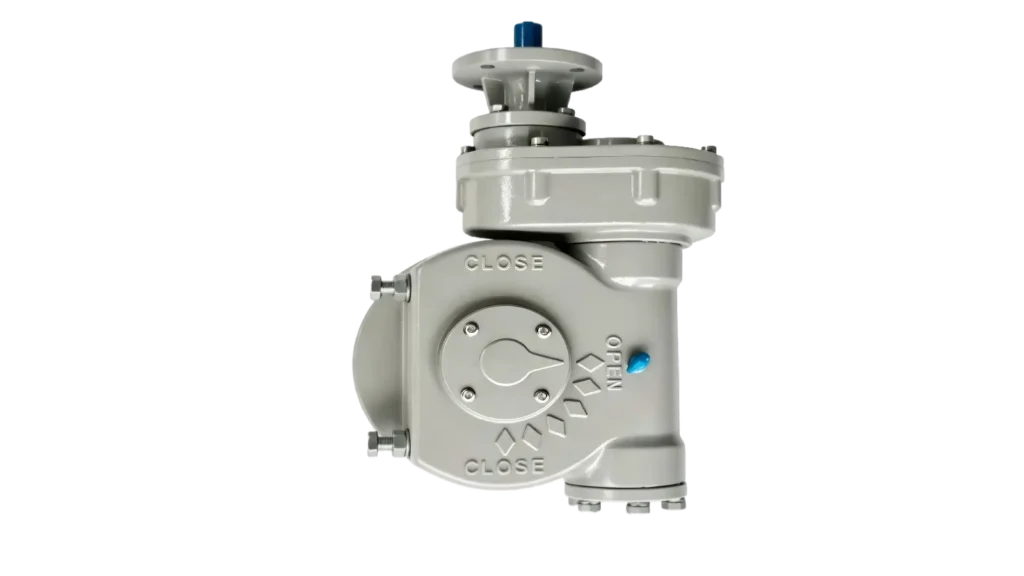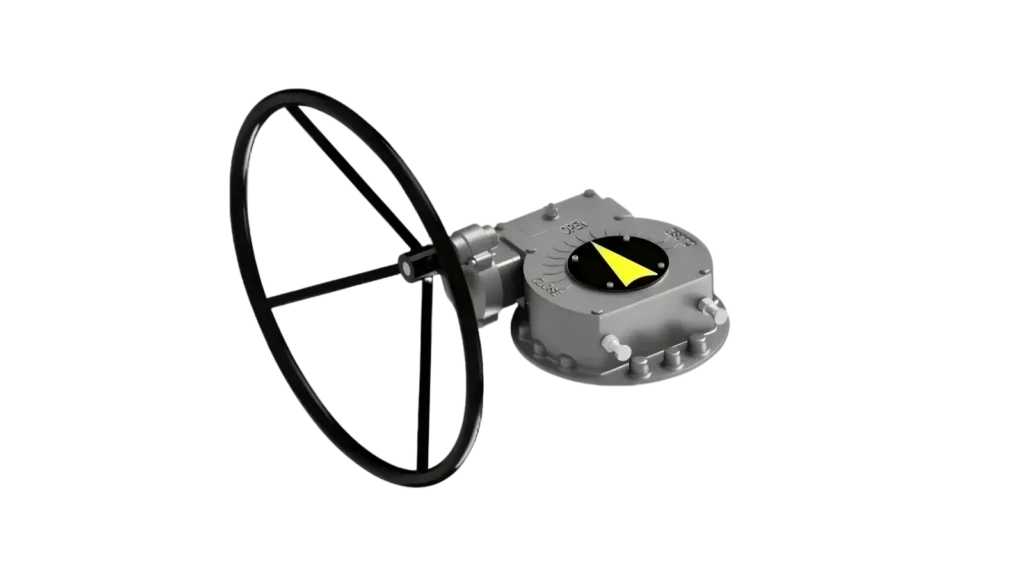
Specifying the right heavy duty declutchable manual override gearbox for a desalination valve package is a decision that standard industrial procurement processes routinely fail to capture. By the time chloride-driven corrosion has compromised housing integrity or a power outage has left an unoperable pneumatic actuator on a critical seawater line, the specification window has long closed — and the cost of that miss falls entirely on the project.
A heavy duty declutchable manual override gearbox for desalination service is not simply a corrosion-resistant upgrade. It is a configuration decision that must address three simultaneous engineering requirements: chloride-environment material specification, power-loss operability without actuator disconnection, and torque delivery under field-degraded conditions. Each of these must be locked at the procurement stage — not resolved at maintenance.
What makes desalination procurement different from general industrial gearbox sourcing is not the harshness of the environment — EPC engineers working in this space already understand the environment. The gap is between what the environment demands and what a standard industrial gearbox specification delivers. The sections below work through that gap in procurement-relevant terms.
Why Do Standard Industrial Gearboxes Fail in Desalination Service?
Standard grey cast iron gearbox housings meet the requirements of most industrial installations. Desalination is not most industrial installations, and procurement teams that treat it as one routinely discover the difference in the field rather than on a datasheet.
The core failure mechanism is electrochemical pitting driven by chloride ions. Grey cast iron — the default housing material for the majority of industrial worm gearboxes — contains graphite microstructure that acts as a cathodic site in a chloride-rich electrolyte1. Seawater and salt mist are both effective electrolytes. Pitting initiates at the graphite-iron interface, progresses under humidity cycling, and cannot be arrested by surface coatings once initiated at a defect site.
Standard zinc-based or alkyd primer coatings extend service life in freshwater industrial environments. They do not reliably protect grey cast iron against sustained salt mist in coastal or offshore desalination installations. Zinc coatings exposed to chloride ions undergo zinc chloride conversion, which is both hygroscopic and non-protective2. Once the coating is compromised at any point — a fastener hole, a machined interface, a transit scratch — chloride attack propagates underneath the remaining coating without visible surface evidence.
What Desalination Actually Demands from Housing Material
In desalination project inquiries we receive, the material question is often raised late — after valve package configurations are already issued for quotation. By that point, substituting duplex stainless steel for grey cast iron requires a commercial renegotiation that most procurement schedules do not accommodate.
The correct approach is to lock housing material specification before vendor selection closes. For desalination service, the minimum credible material baseline is:
- Duplex stainless steel (e.g., 2205 / S31803) for housing castings in direct seawater contact or sustained salt-mist exposure
- Marine-grade epoxy coatings where carbon steel structural elements are unavoidable
- A316L or duplex fastener sets throughout the assembly — standard zinc-plated fasteners corrode faster than the housing under the same conditions and become irretrievable in field service
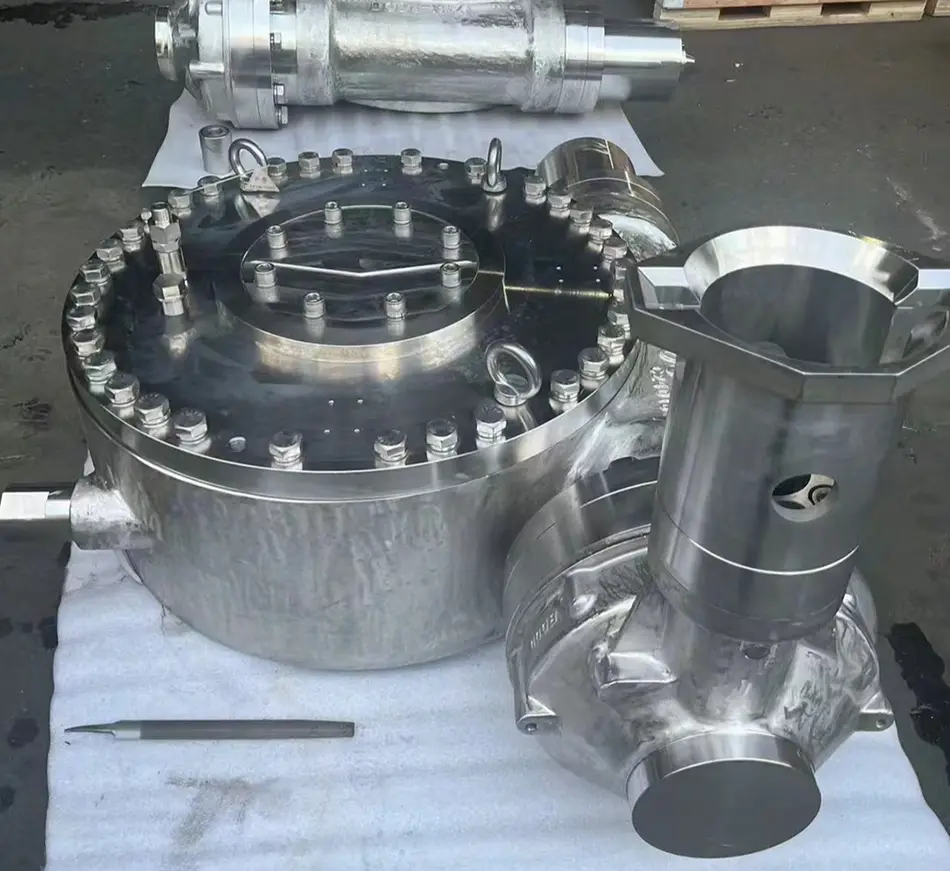
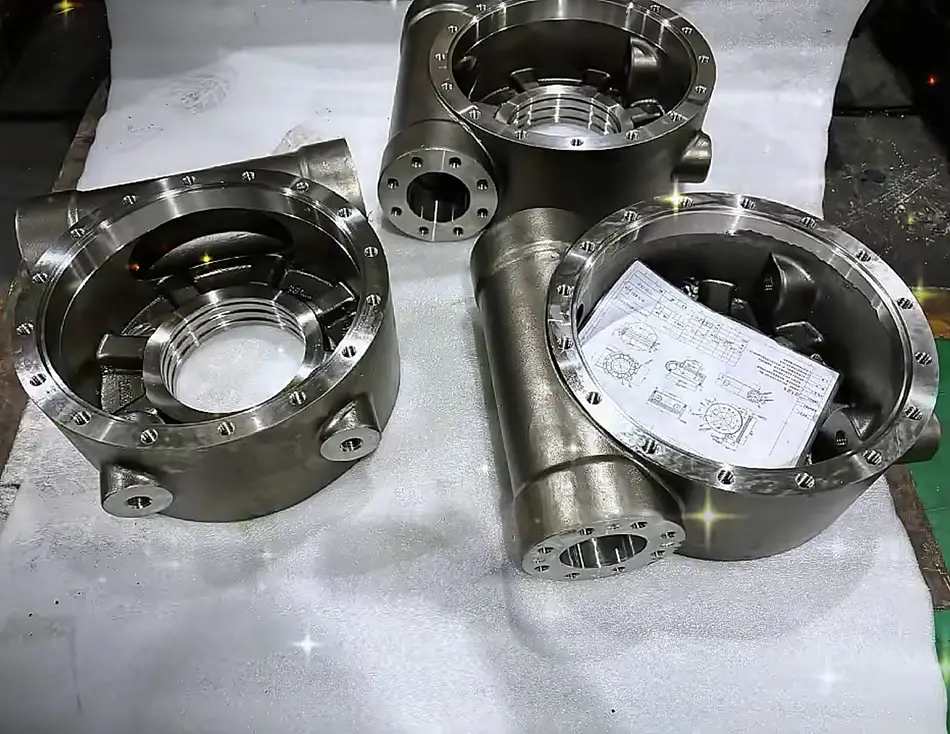
We have supplied duplex stainless steel gearbox housings for projects requiring validated performance at subsea depths up to 1,000 meters. That capability is a useful reference point: the material and sealing engineering required for subsea-rated valve gearboxes substantially exceeds what coastal desalination demands, which means the design knowledge transfers downward reliably.
Why the Substitution Error Persists
The substitution error — sourcing a standard industrial gearbox for a chloride-environment application — persists for three connected reasons:
| Reason | Procurement Consequence |
|---|---|
| Gearbox specified under a generic "valve actuator" line item | Environment severity is not transmitted to the gearbox supplier |
| Material specification not carried through from valve body to gearbox | Valve body is specified in duplex; gearbox arrives in grey iron |
| Cost comparison performed against standard gearbox pricing | Premium material cost appears as a variance rather than a risk reduction |
The last point matters. When a duplex stainless gearbox housing is compared against a standard grey iron unit on a line-item basis, it appears expensive. When it is compared against an in-service replacement on a live desalination plant — requiring shutdown, decommissioning under salt-corroded fasteners, and schedule impact — the calculation reverses. Customers specifying these environments typically ask about material cost early and maintenance cost late.
What Does "Declutchable" Actually Mean in a Pneumatic Valve Application?
The declutchable feature is frequently listed as a checkbox in valve gearbox specifications without a clear account of what problem it solves. In desalination service with pneumatically actuated valves, it solves a specific and consequential problem: how to operate a valve manually during a power or instrument air loss without disconnecting the actuator from the gearbox.
A standard pneumatic actuator without a built-in handwheel has no manual override capability at the actuator level. When instrument air pressure is lost, the actuator locks in position or fails to its spring-return position, depending on the fail mode. If the valve needs to be repositioned — for emergency isolation, flushing, or maintenance — the only option without a declutchable gearbox is to physically remove the actuator from the valve stem interface.
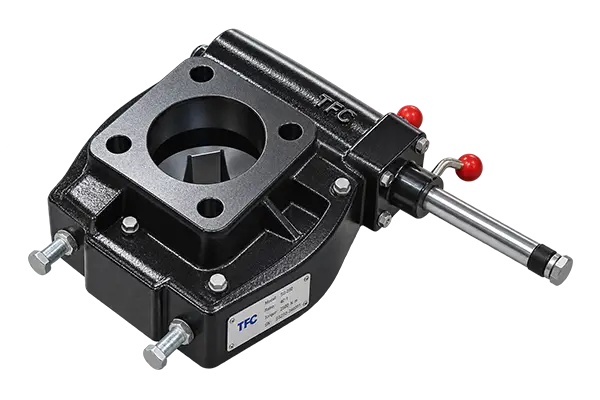
Removing a pneumatic actuator under desalination plant conditions is not a clean field procedure. Fasteners at the actuator-gearbox interface will have been exposed to salt mist for months or years. ISO 5211 mounting flanges with corroded fasteners require significant mechanical force to separate. In an emergency operational scenario — the exactly the scenario where manual override is needed — this represents a meaningful safety and schedule risk.
How the Declutch Switching Mechanism Works
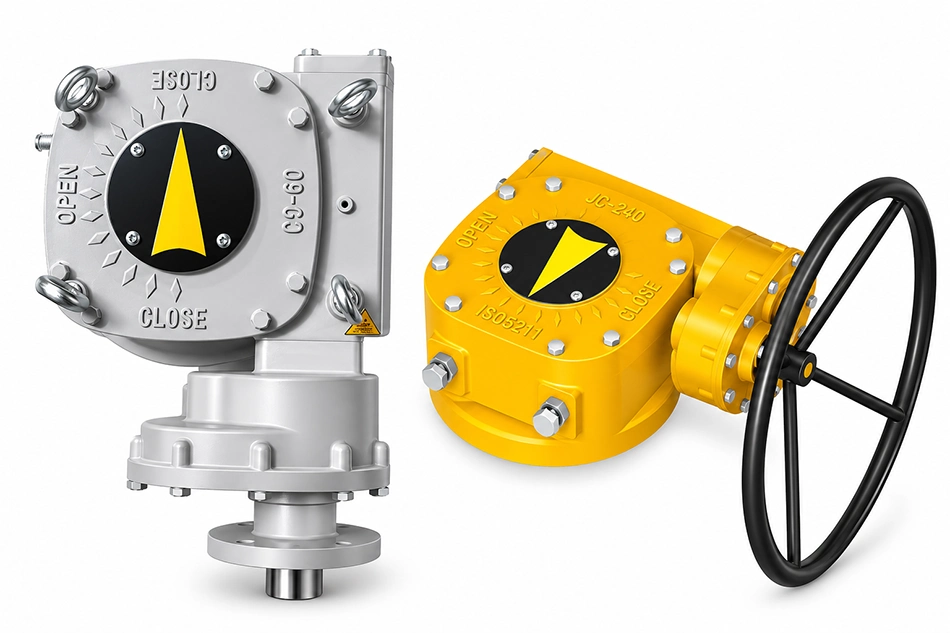
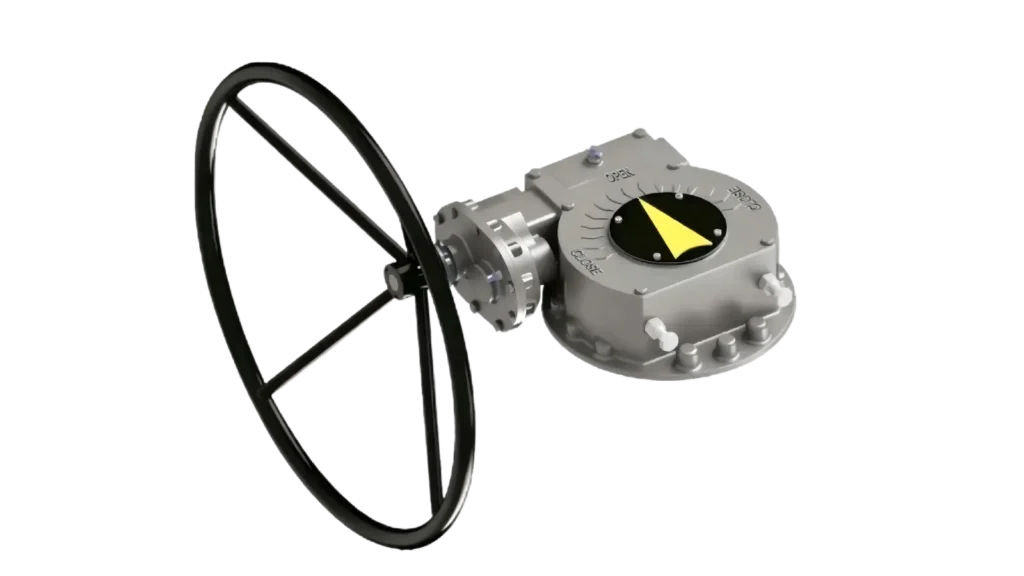
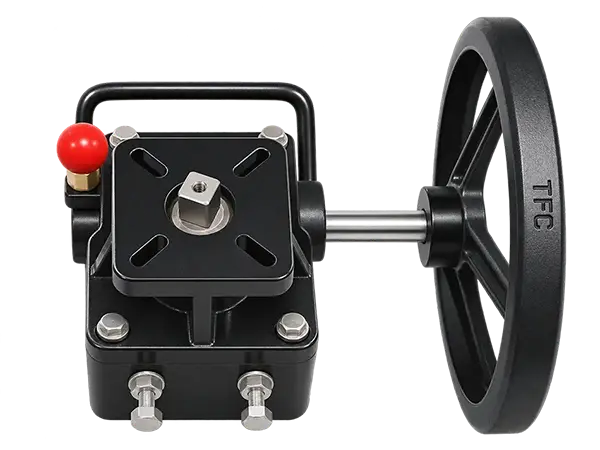
A declutchable manual override gearbox contains an internal clutch assembly that allows the input drive shaft to be disengaged from the actuator drive and re-engaged to a manual handwheel drive. The switching is performed externally — typically via a lever or push-pull pin — without opening the gearbox housing or disturbing the actuator mounting.
The operational sequence in a pneumatic application is:
- Actuator loses instrument air; valve is locked at current position
- Operator engages declutch lever at gearbox — actuator drive is disengaged
- Operator applies manual handwheel — gearbox drives valve stem directly
- Valve is repositioned to required operating position
- When instrument air is restored, operator re-engages actuator drive via the same lever
- Actuator resumes control; handwheel is returned to passive position
The critical feature is step 2 and step 5: the actuator remains mounted throughout. The ISO 5211 flange interface is not disturbed. No fasteners are removed. No hydraulic or pneumatic lines are disconnected.
This is why the declutchable feature is primarily relevant for pneumatically actuated valve gearboxes. Electric actuators typically include a built-in handwheel as standard equipment. The electric motor can be bypassed internally3. For pneumatic actuators — particularly rack-and-pinion or scotch-yoke types common in desalination pipeline applications4 — the declutchable gearbox provides the emergency manual operability that the actuator itself does not carry.
Corrosive Environment Consequences for the Switching Mechanism
In desalination service, the declutch mechanism itself must be evaluated for corrosion exposure. Lever pivots, locking pins, and position indicators that are manufactured from standard carbon steel will corrode in coastal salt-mist environments. When corrosion locks a declutch lever in position, the entire manual override capability is lost — not at the gearbox housing level, but at the engagement mechanism level.
Specification for desalination service should confirm:
- Declutch lever and pivot materials — stainless steel or treated duplex preferred
- Position indicator visibility — corrosion should not make manual/auto state ambiguous
- Engagement torque under degraded conditions — the mechanism should switch under reasonable operator force even after extended service without maintenance
How Does Heavy-Duty Design Address Torque Requirements Under Degraded Conditions?
Torque matching is a necessary starting point for any valve gearbox selection. It is not sufficient for heavy-duty desalination service. The gap between rated output torque and actual manual operability under field-degraded conditions is where the "heavy duty" designation earns its specification.
Rated output torque describes what the gearbox delivers under defined input conditions. Manual input torque describes what a single technician can apply at the handwheel in a real plant environment — standing on a platform, potentially wearing PPE, potentially working in limited access conditions, against a valve that may have a corroded stem packing or a pressure differential across the disc.
Breaking Down the Torque Gap
The standard ergonomic reference for sustained single-operator handwheel force is approximately 250–350 N at a standard handwheel radius5. A heavier-duty handwheel design or a two-operator procedure extends this, but most emergency procedures assume single-operator capability.
The variables that increase the required input torque during emergency manual operation in desalination service include:
- Corroded valve stem packing — friction torque at the stem increases with packing corrosion, potentially doubling break-away torque relative to clean-stem values
- Pressure differential across the valve disc — particularly relevant for butterfly valves and ball valves in seawater service, where pressure imbalance adds significant stem torque
- Reduced gearbox lubrication performance — grease degradation in high-humidity cycling environments increases internal friction
- Operator fatigue and access — emergency operation is rarely performed under ideal physical conditions
A heavy-duty declutchable gearbox sized for desalination service must account for these degraded-condition multipliers, not just rated valve torque. In practice, this means:
| Design Parameter | Standard Industrial Sizing | Heavy-Duty Desalination Sizing |
|---|---|---|
| Output torque basis | Rated valve torque | Rated torque × degradation factor (typically 1.3–1.5×) |
| Handwheel input torque | Nominal ergonomic limit | Verified against corroded-packing scenario |
| Gear ratio selection | Minimum ratio for speed | Ratio selected for manual input torque constraint |
| Housing strength | Rated output torque only | Accounts for shock loading in emergency use |
What "Heavy Duty" Actually Means in This Context
Customers specifying these environments typically ask whether "heavy duty" refers primarily to torque rating. It does not — or at least not exclusively. In the context of a desalination valve gearbox, heavy duty describes a conjunction of three engineering attributes:
- Material grade — housing, fasteners, and mechanism components rated for chloride-environment service
- Sealing class — IP67 minimum for coastal surface installations; IP68 for submerged or regularly flooded applications
- Manual operability under degraded conditions — gear ratio, handwheel design, and declutch mechanism performance confirmed for realistic field-degraded inputs
A gearbox that carries a high torque rating but uses a grey cast iron housing and standard sealing does not meet a reasonable definition of heavy duty for desalination service, regardless of its torque number.
Why Does IP68 Sealing Matter More for Desalination Than for Inland Industrial Sites?
IP-rated sealing is frequently treated as a water-ingress specification. For desalination installations, the relevant threats are more specific and more damaging than general water ingress, and the sealing grade selection should reflect them.
IP67 confirms protection against temporary immersion to 1 meter for 30 minutes. IP68 confirms protection against continuous immersion at a defined depth. For a coastal surface-mounted desalination plant, IP67 provides a reasonable baseline. For offshore or tidal installations, IP68 is the minimum credible specification.
However, the more relevant sealing concern for many desalination installations is not direct immersion — it is the cumulative effect of three interacting mechanisms:
Salt Mist Ingress
Salt mist penetrates gearbox housings through dynamic seals, cable entries, and vent plugs that are entirely adequate for clean-air industrial environments. Once inside, salt mist deposits chloride ions on internal surfaces — gear flanks, bearing races, and housing bores — where they drive corrosion from the inside outward. Internal corrosion of this type is typically not visible during external inspection and is discovered only during maintenance disassembly.
IP-rated static seals address this. Standard labyrinth vents do not.
Condensation Cycling
Coastal and offshore installations experience large diurnal temperature swings. As gearbox housing temperature cycles below the dew point, water vapor inside the housing condenses on internal metal surfaces6. Each condensation cycle deposits contaminants already present in the internal atmosphere — including any salt mist that has previously entered — in liquid form directly on bearing and gear surfaces.
Sealed housings with hygroscopic breather plugs or sealed-for-life lubricant systems reduce this risk. Standard vent-to-atmosphere housings do not.
Lubricant Contamination
Moisture ingress from either salt mist or condensation degrades lubricant performance significantly faster than dry-service lubricant degradation rates. Water contamination in gear lubricant reduces film strength, accelerates micro-pitting on gear flanks, and promotes rust formation on ferrous components7. For gearboxes in desalination service, sealed-for-life lubricant retention — with appropriate lubricant specification for humidity cycling — is preferable to scheduled grease replenishment, which introduces repeated housing-open events under corrosive ambient conditions.
We confirm IP67 and IP68 sealing grades as standard product capabilities for our valve gearboxes specified in desalination and marine environments, with duplex stainless steel housing options available where material specification requires it.
Frequently Asked Questions
Can a standard multi-turn gearbox be used for desalination service if it has a corrosion-resistant coating?
A corrosion-resistant coating on a grey cast iron housing reduces but does not eliminate chloride attack risk in sustained salt-mist environments. Coating systems are vulnerable to mechanical damage during installation, fastener drilling, and routine maintenance access. Once coating integrity is broken, chloride ions attack the underlying grey iron directly. For long-term desalination service, material specification — duplex stainless or equivalent — is more reliable than coating specification alone.
Is the declutchable manual override relevant for all valve types in a desalination plant?
The declutchable manual override is most relevant for valves with pneumatic actuators that have no built-in handwheel — typically rack-and-pinion or scotch-yoke actuated ball valves and butterfly valves on seawater intake and distribution lines. Electric actuator packages generally include a manual handwheel as standard. The specification need is greatest for pneumatically actuated valves on lines where manual repositioning capability is required during power or instrument air loss events.
What torque range is typically required for heavy-duty declutchable gearboxes in desalination valve service?
Torque requirements vary significantly depending on valve type, size, and pressure class. As a reference range, quarter-turn valve gearboxes for desalination service commonly fall between 1,000 Nm and 50,000 Nm output torque8. The more important sizing question is confirming that the gear ratio delivers the required output within single-operator handwheel input limits under degraded-condition assumptions — not just at rated clean-service torque. This requires a torque calculation specific to each valve application.
How does ISO 5211 compatibility relate to declutchable gearbox specification for desalination?
ISO 5211 defines the flange interface between the valve stem, gearbox, and actuator9. In a declutchable configuration, the ISO 5211 interface at both the valve and actuator ends must remain undisturbed during declutch switching. Confirming ISO 5211 compatibility at both interfaces — and confirming that the declutch mechanism does not impose additional loads or displacements at those interfaces — is a standard part of the technical review for pneumatically actuated valve packages in desalination service.
Should gearbox housing material specification be driven by the valve body material or by the installation environment?
Both, in practice — but the installation environment should take precedence where the two diverge. A valve body specified in duplex stainless steel communicates environment severity, but a gearbox housing in a less corrosion-resistant material is still exposed to the same salt-mist environment. The gearbox housing material should be evaluated independently against the installation environment classification, not simply matched to or assumed from the valve body specification.
Conclusion
Specifying a heavy duty declutchable manual override gearbox for desalination valve service requires three simultaneous decisions at the procurement stage: housing material grade against chloride-environment attack, sealing class against salt-mist and condensation ingress, and gear ratio and mechanism design against manual operability under field-degraded conditions. Standard industrial gearbox procurement processes do not reliably capture any of these requirements without explicit specification language.
The declutchable function addresses a real operational risk in pneumatically actuated valve systems — power-loss operability without actuator disconnection — that becomes a significantly greater field problem when fastener and mechanism corrosion is factored in. "Heavy duty" in this context means material grade, sealing class, and degraded-condition operability together, not torque rating alone.
If you are preparing valve package specifications for a desalination project and need engineering input on gearbox material options, sealing grades, or declutchable configuration compatibility, contact TFC directly. We will work from your valve application data and installation environment classification to recommend a configuration that reduces procurement risk before the specification window closes.
"Corrosion Behavior of Cast Iron in Freely Aerated Stagnant ...", https://pmc.ncbi.nlm.nih.gov/articles/PMC5455559/. Studies on cast iron corrosion in saline environments document the graphite network acting as a noble cathodic phase relative to the iron matrix, establishing local galvanic cells that accelerate pitting in chloride electrolytes; see, e.g., corrosion science literature on graphitic corrosion of cast iron. Evidence role: mechanism; source type: research. Supports: The role of graphite microstructure in grey cast iron as a cathodic site promoting galvanic corrosion in chloride-containing electrolytes. Scope note: Specific corrosion rates depend on chloride concentration, temperature, and surface condition; general mechanism studies may not directly replicate desalination plant salt-mist conditions. ↩
"Initial formation of corrosion products on pure zinc in saline ...", https://pmc.ncbi.nlm.nih.gov/articles/PMC6351358/. Corrosion science literature on zinc coating degradation in marine environments identifies zinc chloride as a soluble, hygroscopic corrosion product that does not form a stable passive layer, distinguishing marine exposure from the protective zinc carbonate patina formed in rural or urban atmospheres. Evidence role: mechanism; source type: research. Supports: The conversion of zinc protective coatings to zinc chloride in chloride-rich environments and the hygroscopic, non-protective nature of the resulting corrosion product. Scope note: The rate of zinc chloride formation and its practical impact on coating service life varies with chloride deposition rate, humidity, and coating thickness, which may differ between coastal desalination and offshore environments. ↩
"Electric Valve Manual Override Safety Guide - AOX Actuators", https://www.aox-actuator.com/blog/technical-guides/electric-valve-manual-override-safety-guide/. Industry standards for electric valve actuators, including IEC 60534-6 and manufacturer technical documentation, describe integral manual handwheel override as a standard design feature of electric actuators, allowing valve operation independent of electrical power supply without disconnecting the actuator from the valve. Evidence role: general_support; source type: institution. Supports: That electric valve actuators typically incorporate a manual handwheel and internal motor bypass as standard equipment, providing manual override capability without external gearbox intervention. Scope note: Manual handwheel provision and bypass mechanism design vary between electric actuator manufacturers and product ranges; the characterization of handwheel override as universal standard equipment should be confirmed against specific actuator specifications in a given project. ↩
"Exploring Different Types of Valve Actuators", https://processsupply.com/exploring-different-types-of-valve-actuators/. Engineering references on industrial valve actuation describe rack-and-pinion and scotch-yoke mechanisms as the dominant pneumatic actuator configurations for quarter-turn valves (ball and butterfly) in process plant applications, including water treatment and desalination service. Evidence role: general_support; source type: research. Supports: The prevalence of rack-and-pinion and scotch-yoke pneumatic actuator types on quarter-turn valves in desalination and seawater pipeline applications. Scope note: Actuator type selection in specific desalination projects depends on torque requirements, fail-safe mode, and procurement preferences; no single source documents actuator type distribution across the desalination industry. ↩
"Industrial handwheel actuation and the human operator", https://www.sciencedirect.com/science/article/abs/pii/S0169814101000269. Ergonomic standards and human factors guidelines for industrial manual controls, including EN 894-3 and related ISO guidance on force limits for hand-operated controls, provide reference values for sustained operator input force that inform manual override sizing calculations. Evidence role: statistic; source type: institution. Supports: The ergonomic limit for sustained single-operator handwheel input force, used as a basis for manual override gear ratio selection. Scope note: Published ergonomic force limits represent population-level design references and do not account for site-specific factors such as PPE, platform access constraints, or operator fatigue under emergency conditions. ↩
"Twentieth century trends in dew point temperature ...", https://www.meteor.iastate.edu/~jwartman/portfolio/Thesiscolor.html. Environmental engineering and corrosion protection literature describes condensation-driven internal corrosion in sealed enclosures as a function of diurnal temperature amplitude and internal humidity; coastal and marine environments with high ambient humidity and significant day-night temperature differentials are identified as high-risk conditions for this mechanism. Evidence role: mechanism; source type: research. Supports: The mechanism by which diurnal temperature cycling in coastal environments causes internal condensation in sealed enclosures, contributing to corrosion of internal metal surfaces. Scope note: The severity of internal condensation depends on enclosure thermal mass, seal quality, and local climate; general coastal environment characterizations may not reflect conditions at specific desalination plant sites. ↩
"An overview of grease water resistance", https://repository.lsu.edu/cgi/viewcontent.cgi?article=2173&context=mechanical_engineering_pubs. Tribology and lubrication engineering literature documents that water contamination in gear oils reduces elastohydrodynamic film thickness, lowers the lubricant's load-carrying capacity, and promotes hydrogen embrittlement and micro-pitting fatigue on gear flanks, with corrosion of ferrous surfaces accelerated by dissolved oxygen in the water phase. Evidence role: mechanism; source type: research. Supports: The mechanisms by which water contamination in gear lubricants reduces elastohydrodynamic film strength, promotes micro-pitting on gear tooth flanks, and accelerates corrosion of ferrous gear components. Scope note: The severity of lubricant degradation depends on water concentration, lubricant base stock type, and additive package; general tribology findings may not quantitatively predict service life in specific desalination gearbox configurations. ↩
"Desalination Plant Valves: Models and Applications", https://www.omal.com/en/news/2026/valves-for-desalination-plants-types-applications-and-certifications.html. Valve engineering references and actuator sizing standards indicate that quarter-turn valve operating torques span several orders of magnitude depending on valve size, pressure class, and fluid conditions; for large-diameter seawater valves typical of desalination intake and distribution systems, gearbox output torque requirements in the range of thousands to tens of thousands of Newton-metres are consistent with published valve torque calculation methods. Evidence role: statistic; source type: research. Supports: The typical output torque range for quarter-turn valve gearboxes used in desalination and large-diameter seawater pipeline applications. Scope note: The cited range is illustrative; actual torque requirements must be calculated for each valve application using valve-specific torque data, pressure differential, and applicable safety factors per relevant standards such as EN 12570 or equivalent. ↩
"INTERNATIONAL STANDARD ISO 5211", https://cdn.standards.iteh.ai/samples/62594/99f2c2aed9e24049bf1985c541d19143/ISO-5211-2017.pdf. ISO 5211 (Industrial Valves — Part-Turn Actuator Attachment) specifies the dimensions and requirements for the interface between part-turn valves and their actuators, including gearboxes, and is the normative reference for confirming dimensional compatibility in valve-gearbox-actuator assemblies. Evidence role: definition; source type: institution. Supports: ISO 5211 as the governing international standard for mounting flange interfaces between industrial valves, gearboxes, and actuators. Scope note: ISO 5211 covers part-turn actuator interfaces; multi-turn valve gearbox interfaces are governed by separate standards, and the article's reference should be understood in the context of quarter-turn valve applications. ↩